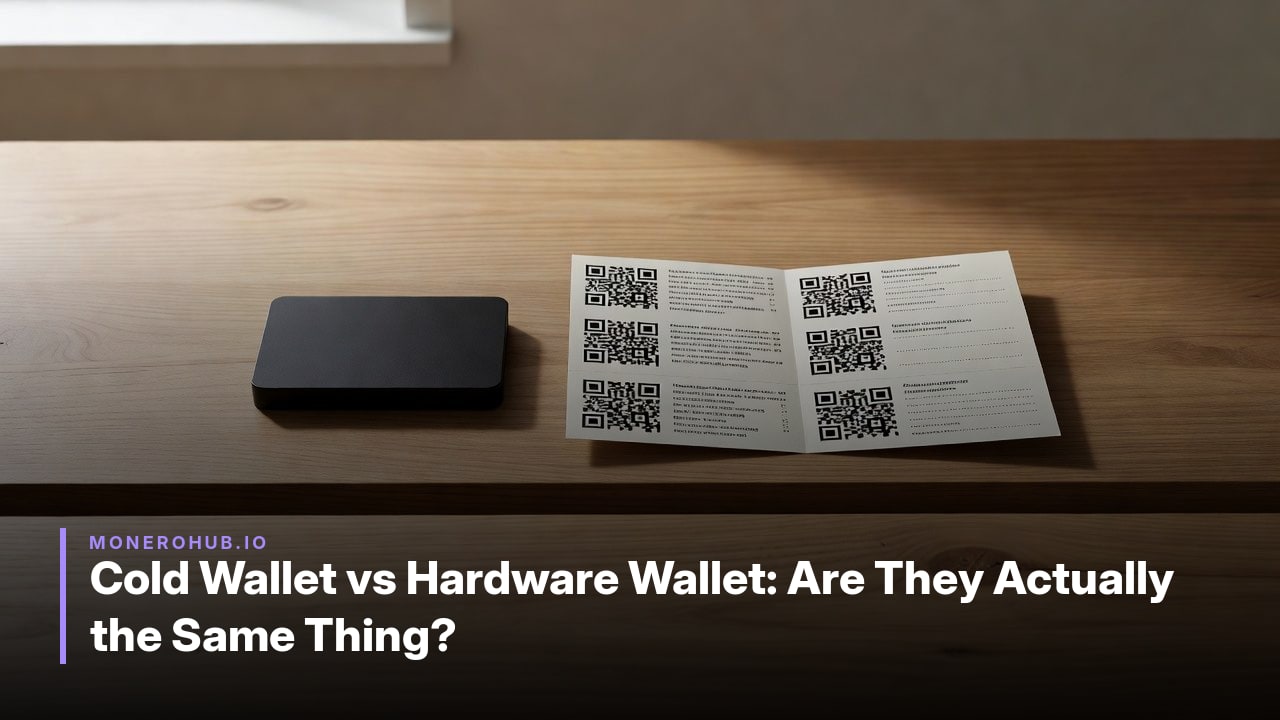
Cold wallet vs hardware wallet clarified with definitions, usage rules, pricing data and Monero-specific OPSEC so you can choose the right offline storage method.
A hardware wallet is a physical electronic device that stores private keys in a secure chip or element and signs transactions internally without exposing the keys to the connected computer or phone. It can connect temporarily to a host device for transaction approval but keeps keys offline, according to definitions from Trezor and Wikipedia.
A cold wallet is any method of storing private keys completely offline and disconnected from the internet at all times, with no interaction with smart contracts or dApps. It is used solely for holding assets and simple transfers or receipts. Examples include paper wallets, metal backups, air-gapped computers, and certain hardware wallets used exclusively in offline mode, as noted by Ledger and Investopedia.
Hardware wallets and cold wallets are not identical. Hardware devices become cold storage only when kept fully offline and non-interactive. A hardware device can be used interactively, such as signing smart contracts via companion software, which reduces its cold status. Cold wallets emphasize permanent isolation and storage-only use to avoid on-chain risks like malicious approvals.
Ledger updated its terminology in 2026, shifting from hardware wallets to signers across products to clarify that devices sign transactions rather than store value on the device itself.
Hardware wallets keep private keys inside a dedicated secure element chip and never export them. A host device prepares the transaction data and sends only the unsigned hash to the wallet over a temporary USB or Bluetooth link. The wallet displays the details on its screen for user confirmation, then performs the elliptic curve signature calculation entirely within the chip before returning the completed signature.
This internal process creates an effective air gap for the keys even though the device connects briefly. The host never sees the private key material and cannot extract it. Ledger devices use EAL6+ Secure Element chips for this isolation, while Trezor models employ comparable hardware protections, including dual-element designs in newer releases. Both manufacturers now describe their products as signers to underscore that the device’s role is transaction approval rather than value storage.
When restricted to holding assets and executing simple transfers without smart-contract approvals or dApp interactions, these devices meet the stricter usage criteria of cold storage. The temporary connection serves only to relay data; the keys remain offline at all times and the workflow avoids the on-chain risks that interactive use would introduce.
Hardware wallets lose cold status once users enable interactive signing through companion software for dApps or smart contracts. The device remains offline for key storage, yet the approval workflow now processes on-chain interactions that cold wallets prohibit by definition.
Ledger requires deliberate cold-account segregation within its devices. Separate accounts must stay isolated from any contract or dApp activity, or the hardware signer no longer qualifies as true cold storage.
The July 2026 Coinkite incident showed the practical outcome. A software bug on their cold wallet devices produced approximately $130 million in losses, reported as of early August 2026. The event confirmed that bugs or expanded usage patterns can bridge the isolation gap even when keys never leave the secure element.
Hardware wallets occupy the $50–$200 price band. Concrete model pricing reveals clear tiers that affect which users choose electronic devices over simpler offline backups.
| Method | Price | Key Features | Trade-offs |
|---|---|---|---|
| Ledger Nano S Plus | Approximately 41 euros | Secure Element chip, compact USB form | Entry-level screen and button interface |
| Trezor Safe 3 | $59 | Secure Element, basic touchscreen | Limited advanced connectivity |
| Ledger Nano Gen5 | $179 | EAL6+ Secure Element, larger screen, Bluetooth/NFC options | Higher cost for added wireless features |
| Trezor Safe 7 | 249 euros | Dual secure elements, quantum-ready design, wireless charging, full touchscreen | Premium pricing for newest hardware |
| Paper wallet | Minimal (well below hardware range) | Printed keys and QR codes, zero electronics | No built-in signing; manual transcription required |
| Metal backup | Minimal (well below hardware range) | Engraved seed phrases, fire- and water-resistant | Still requires separate signing device or air-gapped computer |
Paper and metal options therefore sit at the low end of total expenditure while hardware models add convenience at increasing cost. The $50–$200 range cited by Investopedia as of August 27, 2026 shows that buyers pay mainly for the secure chip and user interface rather than storage capacity itself.
Monero cold storage requires strict separation of key generation and signing from any networked device. Generate the wallet seed on an air-gapped computer or dedicated offline machine, then export only the public address and view key via QR code or removable media that never re-enters the online environment.
Acquire XMR using non-custodial peer-to-peer channels or decentralized exchanges that accept cash or privacy coins; identity verification may be requested in specific compliance-related situations. Once funded, move the full balance to the cold address in a single transaction to minimize on-chain exposure.
Prevent clearnet node leaks by running a personal Monero node behind Tor or I2P and configuring the offline wallet to broadcast only through that hidden service. Avoid connecting hardware signers to companion apps that default to public remote nodes.
Limit the cold setup to non-interactive transfers. Sign only simple send or receive transactions; never approve complex operations or connect the device to any service that could request additional data. Verify each signed transaction on a second offline viewer before broadcasting.
Store metal or paper backups of the seed in separate physical locations and test restoration annually on a clean machine. Any online interaction, even for balance checks, must route exclusively through the private node to preserve the isolation that defines true cold storage.
Hardware wallets function as one form of cold storage only when kept fully offline and non-interactive with dApps. Strict cold wallets add permanent isolation rules that hardware devices can violate through companion software.
Current models cost between $50 and $200. Specific examples include the Trezor Safe 3 at $59, Ledger Nano S Plus near 41 euros, Ledger Nano Gen5 at $179, and Trezor Safe 7 at 249 euros.
A July 2026 software bug on Coinkite cold wallet devices produced roughly $130 million in losses according to reports from early August 2026.
Paper wallets provide the simplest non-electronic offline option for pure storage, though they require manual handling and lack built-in transaction signing screens found on hardware devices.
Devices that remain strictly offline can sign Monero transactions, but users must confirm firmware support and avoid any online companion features that would compromise cold status.
Only those used exclusively for offline signing and never connected to smart-contract platforms meet cold wallet criteria; interactive use reduces their isolation level.
