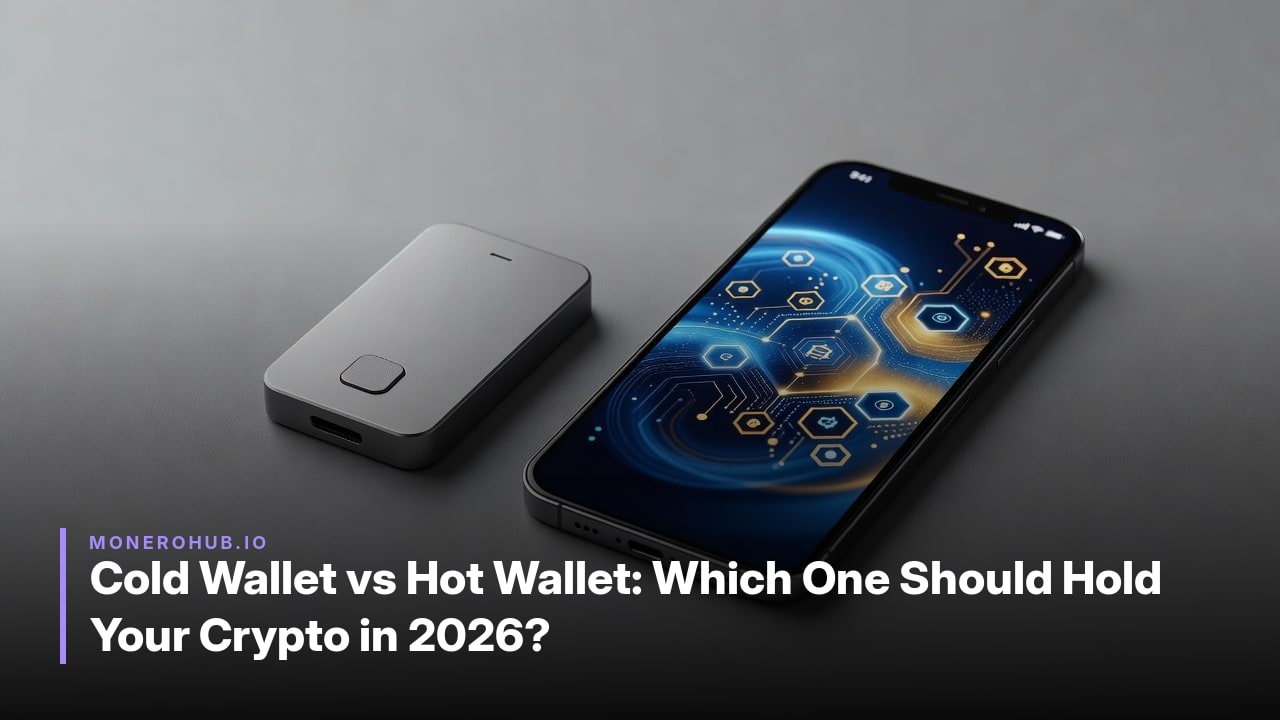
Compare cold and hot wallets for 2026 crypto storage using 2026 market data, hack statistics, and security trade-offs to decide the right approach.
Hot wallets consist of internet-connected software such as mobile apps or browser extensions that keep private keys online at all times. Cold wallets store private keys offline on hardware devices, paper, or air-gapped media that never connects to the internet.
In a hot wallet the keys reside in software running on a device exposed to networks, allowing immediate transaction signing but leaving the keys reachable by remote code. A cold wallet generates and holds the keys on isolated hardware or printed material, so signing occurs only after the user physically connects the device or copies a signed transaction.
Hot wallets therefore retain attack surfaces that include malware on the host device, phishing sites that capture seed phrases, and exploits against the wallet application itself. Cold wallets remove those remote internet vectors entirely. Their remaining risks shift to physical theft, loss of the device or paper, and supply-chain tampering during manufacturing.
The distinction is strictly operational: hot wallets trade continuous online exposure for speed and convenience, while cold wallets trade occasional manual steps for the elimination of network-based key theft.
Between January 2025 and July 2026, crypto platforms suffered $3.63 billion in losses across 245 incidents, according to the CoinGecko State of Crypto Security Report. The single largest event was the February 2025 Bybit breach, which alone accounted for $1.44 billion. Most of these losses stemmed from remote exploits targeting hot wallets and connected infrastructure, including malware, phishing, and private-key compromises that doubled in volume year-over-year.
Cold wallets shift exposure away from internet-based attacks but introduce physical and supply-chain risks. A software bug in Coinkite Coldcard devices, disclosed in late July 2026, produced roughly $130 million in losses by early August—the first reported remote-style compromise of a hardware product line. The incident triggered immediate sales spikes at competing vendors and highlighted that even offline devices remain vulnerable to flawed firmware or update processes.
Hot-wallet users therefore face ongoing remote-attack surfaces, while cold-wallet holders must weigh device integrity, seed storage, and vendor trust. Infrastructure and key-management failures continue to dominate loss statistics rather than smart-contract bugs alone.
The global crypto wallet market stood at $12.52 billion in 2026, according to Mordor Intelligence data referenced in the Quantumrun summary of May 28, 2026. Hot wallets continued to dominate active use at 72–78% of wallets, while cold wallets held a 22–30% share, per Traders Union statistics dated August 28, 2026.
Hardware wallet sales rose 31% in 2025. After the late-July 2026 disclosure of a Coinkite Coldcard software bug that produced roughly $130 million in losses, August 2026 saw clear sales spikes at Trezor, OneKey and Bitbox as users sought alternative cold-storage options.
Hot wallets account for 72–78% of usage while cold wallets hold 22–30% as of August 28, 2026 per Traders Union data. The table below compares key operational factors using verified 2026 figures.
| Aspect | Hot Wallet | Cold Wallet | Source Attribution |
|---|---|---|---|
| Typical Cost | Free or low software fees | $50–$200 (basic models often ~$79) | Traders Union / Gnosis blog, May–August 2026 |
| Transaction Speed | Near-instant on connected devices | Slower due to offline signing and physical connection | Core distinction from Wikipedia 2026 summary |
| Remote Attack Exposure | High; primary target for malware and exploits | Low; keys stored offline | Wikipedia and CoinGecko report, August 2026 |
| Physical Loss Risk | Low for software instances | High; device theft or damage shifts risk from remote vectors | Traders Union analysis, August 28, 2026 |
| Recovery Options | Seed phrase backup on connected apps | Seed phrase plus hardware-specific recovery; supply-chain checks required | Multiple 2026 sources including Wikipedia |
| 2026 Usage Share | 72–78% | 22–30% | Traders Union, data as of August 28, 2026 |
Hardware sales grew 31% in 2025 amid rising incident awareness. Cold wallets reduce remote exposure but introduce physical and supply-chain considerations absent in hot wallets.
Daily traders who move assets frequently benefit from hot wallets because they support quick on-chain actions without physical device handling. Long-term holders reduce remote attack exposure by storing keys in cold wallets that remain offline except during deliberate transfers.
The core trade-off is speed versus isolation. Hot wallets enable immediate swaps or DeFi interactions yet stay connected to networks that malware and phishing target. Cold wallets add friction through manual signing or device connection but eliminate internet-based key extraction vectors.
Privacy-coin users must also examine on-ramp and node choices. KYC exchanges link purchase records to wallet addresses, weakening Monero’s built-in privacy even when the coin itself hides transaction details. Running a clearnet node for Monero broadcasts IP addresses that can correlate activity unless traffic routes through Tor or I2P. Selecting a wallet setup therefore requires matching the chosen device type to the specific threats of frequency, custody duration, and potential identity leaks at every layer of the workflow.
Hardware wallets generally range from $50 to $200, with basic models often listed around $79 according to multiple 2026 sources including Gnosis and Traders Union.
Cold wallets keep private keys offline and normally eliminate remote internet attack vectors. However, a software bug in Coinkite Coldcard devices disclosed in late July 2026 enabled a remote-style compromise that caused roughly $130 million in losses by early August 2026.
The incident prompted a noticeable sales spike at competing vendors such as Trezor, OneKey, and Bitbox in August 2026 and accelerated discussion around evolving security models for hardware devices.
Many users keep smaller amounts in hot wallets for daily transactions while storing the majority in cold storage. This split reduces exposure to the remote attacks that dominate hot-wallet incidents without sacrificing all convenience.
Cold wallets shift risk away from remote hacks toward physical theft, loss of the device, or supply-chain issues. They do not remove the need for careful backup and recovery procedures.
Infrastructure and private-key compromises, which primarily affected hot wallets and exchanges, drove the bulk of the $3.63 billion in reported losses across 245 incidents between January 2025 and July 2026.
