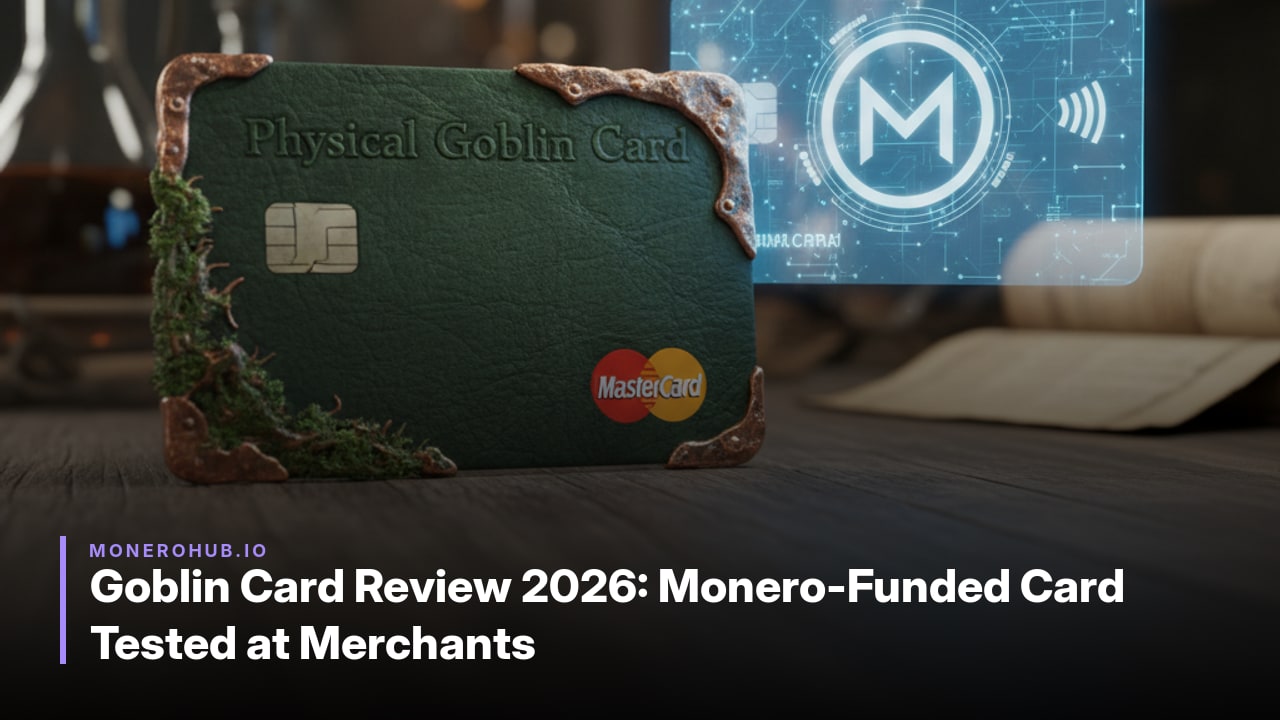
Review of the Goblin Card no-KYC physical Mastercard and virtual Visa bundle funded directly with Monero, covering fees, limits, merchant performance and privacy trade-offs as of late 2026.
Goblin Card supplies a $350 one-time bundle that pairs a physical Mastercard with an MXN balance and a separate virtual Visa with a USD balance. The fee includes tracked international shipping and support. The physical card supports chip and contactless payments, ATM withdrawals, and automatic conversion across USD, EUR, MXN and other currencies. It carries a three-year validity period.
The service runs from a Mexico-based entity and operates under a no-KYC policy that requires no identity documents. Founded around May 2025, the product targets privacy-focused users who want direct cryptocurrency funding options.
Current access centers on a web dashboard for ordering, deposits, and balance checks via passkey login, with continued Telegram bot support. The virtual card adds Apple Pay and Google Pay compatibility plus 3DS authentication. Both cards are managed through the same platform at goblincards.com.
Goblin Card accepts direct on-chain deposits in BTC, ETH, SOL, XMR, and USDT. Each deposit carries a $100 minimum and routes through either the web dashboard or Telegram bot.
Deposit fees stand at 3.5% for BTC, ETH, SOL, and USDT. XMR deposits incur a 4% fee to cover DEX swap costs that convert the privacy coin into the card’s MXN balance. XMR top-ups credit after one confirmation, providing faster access than many custodial services.
The web app supports passkey login for deposits and balance checks, while the Telegram bot offers an alternative interface for the same functions. Both channels operate without KYC requirements. Users report reliable XMR processing since early 2026, with the service maintaining its Monerica listing as of October 2026.
Support for deposit issues routes through Telegram (@banklessinlatam) or encrypted SimpleX. No other funding methods, such as bank transfers or third-party ramps, appear in current documentation.
The physical Mastercard and virtual Visa differ substantially in limits and features. The physical card caps single transactions at $2,500 USD with a $5,000 USD daily spend limit and $500 USD daily ATM withdrawal. It carries no monthly cap and applies 0% FX fees using xe.com rates plus 0% Goblin ATM fees, though operator surcharges may still apply.
| Feature | Physical Mastercard | Virtual Visa |
|---|---|---|
| Per Transaction Limit | $2,500 USD | $200,000 USD (online) |
| Daily Spending Cap | $5,000 USD | $20,000 USD (tap-to-pay); $200,000 USD (online) |
| Daily ATM Withdrawal | $500 USD | Separate rules apply |
| FX Fees | 0% (xe.com rates) | ~1.5% (varies by review) |
| ATM Fees | 0% Goblin fees (operator surcharges may apply) | ~2% |
| Apple Pay Support | Not specified | Yes, plus Google Pay and 3DS |
These figures come from the Goblin Card FAQ and secondary reviews current as of October 2026. The virtual card’s higher limits suit larger online purchases, while the physical card provides reliable ATM access. Apple Pay availability on the virtual card improves contactless convenience in supported regions. Users should verify current operator ATM charges and note that virtual FX and ATM fees show minor differences across published sources.
2026 user reports on platforms including X show reliable spending with both the physical Mastercard and bundled virtual Visa. Heavy users running multiple cards have loaded thousands of dollars via XMR and spent them at physical merchants, online retailers such as Amazon, ATMs, and locations across the US, Europe, and Japan.
The physical card handled chip and contactless transactions at everyday merchants with automatic currency conversion. ATM withdrawals worked in the same regions, subject only to operator surcharges. The virtual Visa stood out for online and tap-to-pay use, integrating with Apple Pay and Google Pay while recording fewer declines than the physical card in several accounts.
Users noted XMR deposits confirming in one block and immediate availability for spending. Daily resets on the $5,000 spending and $500 ATM limits supported repeated testing without monthly caps. Feedback remains positive on merchant acceptance and dashboard management, with the virtual card often preferred for higher-volume or international online purchases. Isolated concerns about issuer transparency appear in one thread but lack supporting incident reports.
The no-KYC model hides your personal identity from Goblin Solutions LLC at signup and funding time. It does not hide the fact that the service holds custody of your balances after each on-chain deposit, nor does it prevent the operator from seeing which addresses you use or how the converted funds move onto the Mastercard or Visa.
Two structural weak points remain. First, custodial control gives the issuer the ability to freeze cards or share internal records with authorities without needing external KYC data. Second, the web portal and Telegram bot run on clearnet infrastructure, so every login, deposit, or balance check can expose an IP address unless routing is changed.
Practical steps reduce these exposures. Connect to the dashboard and deposit functions only through Tor or a no-logs VPN. Generate a fresh Monero sub-address for each top-up instead of reusing one. Log in with the passkey option rather than a password. Route any support questions through the encrypted SimpleX channel listed on the site. After loading funds, spend from the virtual Visa where possible to limit the physical card’s exposure at point-of-sale terminals.
These measures limit what the service can observe by default, yet they cannot eliminate the custodial link between your deposits and subsequent spending activity.
Shipping takes approximately 7 days and up to 14 days maximum for tracked international delivery, according to the provider’s FAQ as of late 2026.
Yes. Referral codes such as “MAV” reduce the $350 bundle price to $335, as noted in October 2026 user reports.
User reports from 2026 indicate successful merchant and ATM use, with the virtual card showing fewer declines than the physical card in some cases. Exact rates are not published.
The virtual card offers higher limits than the physical version, including examples of $20,000 daily tap-to-pay and $200,000 per transaction or day for online use.
The service launched around May 2025 and remains under two years old as of October 2026. Positive user feedback continues, though some isolated concerns about issuer transparency exist without confirmed incidents.
Yes. Heavy users report managing multiple physical and virtual cards through the dashboard for separate balances and spending.
