Compare simple interest and compound interest formulas with concrete examples, growth differences, and practical implications for borrowers and savers.
Simple interest is calculated solely on the original principal amount. This means that each period, the interest remains the same because it does not take into account any interest that has already been added to the balance. Compound interest, however, is calculated on the principal plus any accumulated interest from prior periods. As a result, the interest amount grows over time as the base on which it is applied increases.
The standard simple interest formula is I = P × r × t, where I represents the interest amount, P is the principal, r is the annual interest rate expressed as a decimal, and t is the time in years. The total balance or future value can then be expressed as B = P(1 + rt). These formulas are foundational in financial mathematics and appear consistently across educational resources.
In comparison, the standard compound interest formula for the future value, known as the accumulated amount, is A = P(1 + r/n)^(nt). Here, n stands for the number of compounding periods per year. The interest earned is the difference between A and P. This structure allows for interest to be added to the principal at regular intervals, leading to further interest calculations on the new total.
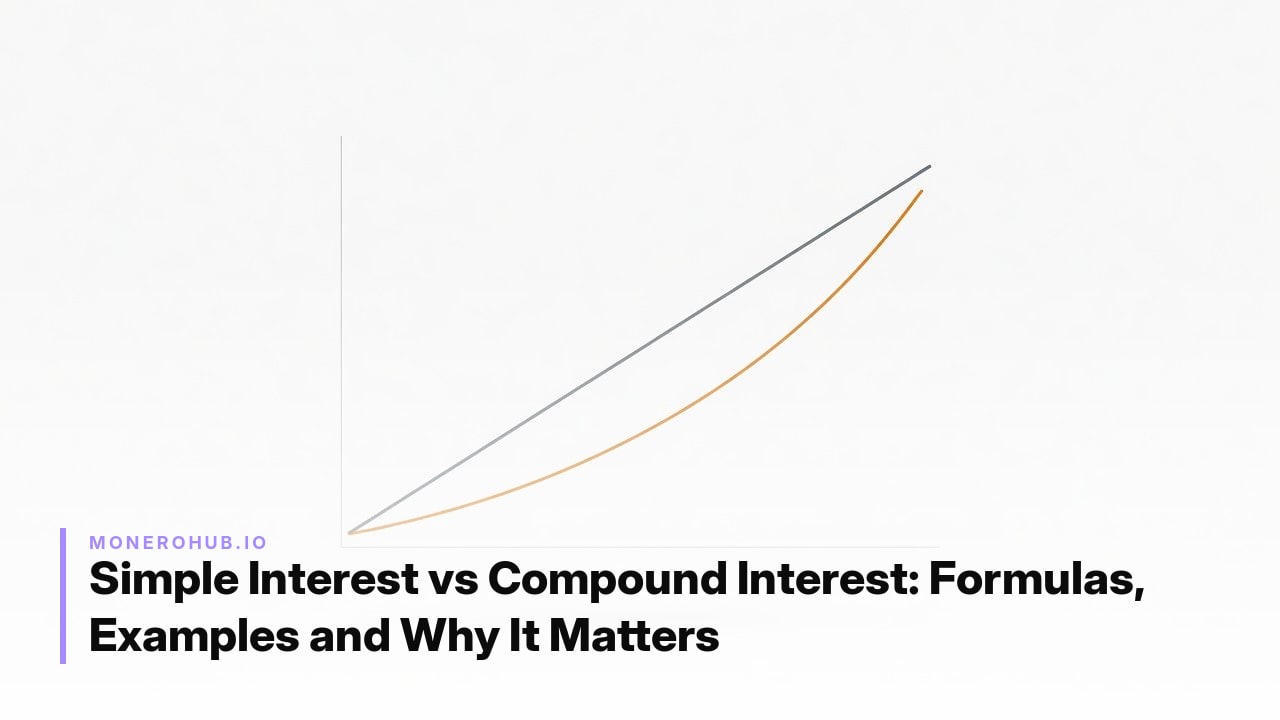
Simple interest follows a linear growth pattern because the interest addition remains constant regardless of time passed or prior earnings. Compound interest follows an exponential growth pattern because the rate of increase accelerates as the accumulated interest becomes part of the new principal for subsequent calculations. The distinction in growth patterns arises directly from whether interest is applied only to the initial amount or to the expanding balance.
To calculate simple interest on a $10,000 principal at 6% for 3 years, apply the formula I = P × r × t. Substitute the values: I = 10,000 × 0.06 × 3. This yields exactly $1,800 in interest.
The result stays identical even if the three-year period is split into smaller segments, such as six months or one year at a time. Because interest never compounds on prior interest, recalculating over any sub-periods and summing them produces the same $1,800 total. This linear property holds for any combination of P, r, and t under the simple interest model.
The compound formula requires direct substitution of each variable into A = P(1 + r/n)^(nt).
Each step confirms that more frequent compounding raises the accumulated amount while the stated rate and term remain fixed.
| Scenario | Principal | Rate | Time | Compounding Frequency | Total Interest | Growth Type |
|---|---|---|---|---|---|---|
| Simple interest baseline | $10,000 | 6% | 3 years | N/A | $1,800 | Linear |
| Compound annual | $10,000 | 5% | 3 years | Annually | $1,576.25 | Exponential |
| Compound long-term annual | $10,000 | 10% | 10 years | Annually | $15,937.42 | Exponential |
| Compound long-term monthly | $10,000 | 10% | 10 years | Monthly | $17,059.68 | Exponential |
The table places the three verified calculations side by side so differences in interest earned become visible at a glance. The simple-interest row grows strictly with time, while the compound rows accelerate once interest begins earning interest. Extending the term from three to ten years multiplies the gap dramatically, and switching from annual to monthly compounding adds another $1,122 in the final example. Borrowers therefore prefer the linear simple-interest structure because the total repayment stays lower. Savers and investors gain from the exponential pattern, especially when the rate is higher or compounding occurs more often.
Simple interest keeps total repayment lower for borrowers on multi-year loans because charges apply only to the original principal. This structure produces linear cost growth and helps maintain more predictable cash outflows over time.
Compound interest delivers higher long-term gains for savers and investors. Each period adds returns on both the starting amount and all prior interest, creating faster accumulation when compounding happens more often or extends across longer horizons.
Borrowers therefore gain by negotiating simple-interest terms on extended credit facilities, while savers benefit from selecting vehicles that compound frequently. The advantage widens with each additional year or extra compounding cycle.
These patterns guide everyday choices such as selecting loan products, savings accounts, or investment vehicles. All cited figures in related examples remain illustrative calculations only and do not represent current market rates or specific financial products.
The standard simple interest formula is I = P × r × t, where I is interest, P is principal, r is the annual rate as a decimal, and t is time in years; total balance equals P + I or P(1 + rt).
The compound interest future value formula is A = P(1 + r/n)^(nt), where n is compounding periods per year; interest earned equals A minus P.
Simple interest applies to many short-term loans and certain savings products where interest is calculated only on the original principal.
More frequent compounding, such as monthly instead of annually, increases total returns because interest begins earning interest sooner under the compound formula.
Compound interest produces exponential growth while simple interest produces linear growth, resulting in higher balances over longer periods or with higher frequency.
Borrowers generally pay less total interest under simple interest structures because no interest accrues on accumulated interest.
Compare projected totals using both formulas on the same principal, rate, and time; select the option that minimizes cost for loans or maximizes return for savings.
