Compare Tangem card wallets against Ledger devices for Monero users, covering privacy trade-offs, setup differences, and real-world OPSEC risks in 2026.
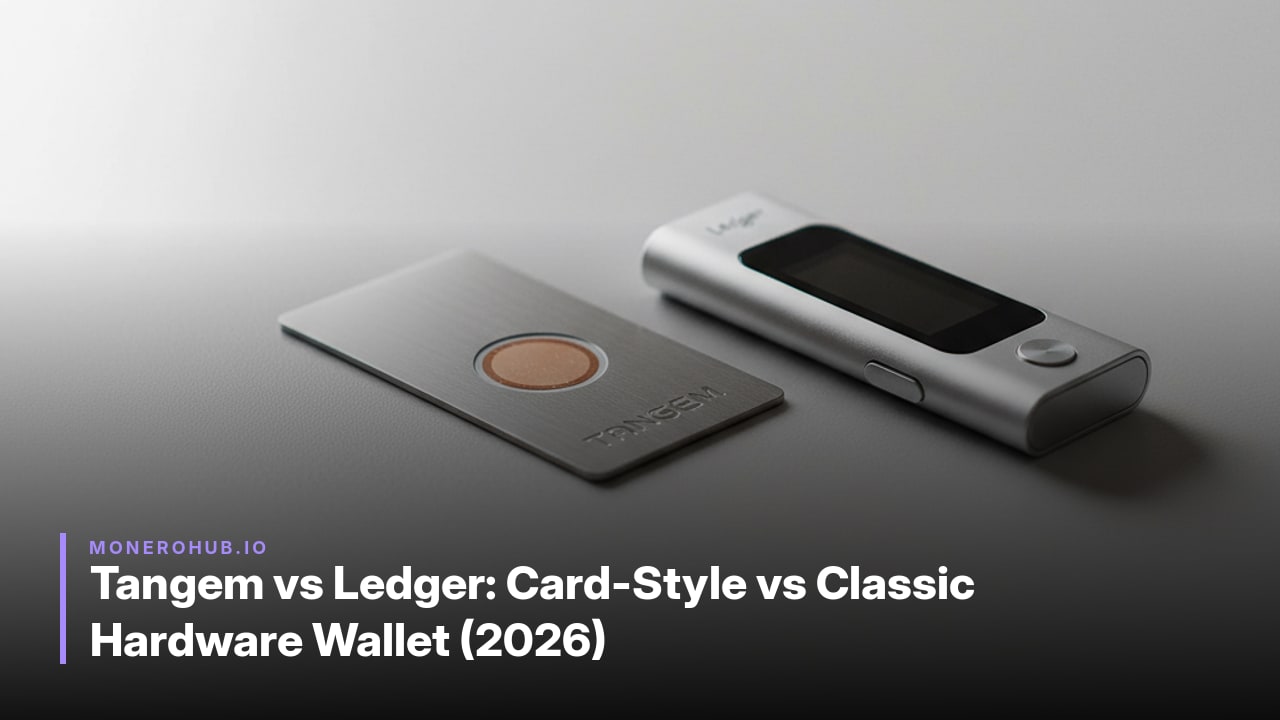
Tangem uses a credit-card form factor with an EAL6+ Samsung secure element that generates and stores keys on-chip. The device has no screen, battery, USB, or Bluetooth, so it communicates only via NFC with the companion mobile app. Default setup is seedless: multiple identical cards serve as encrypted backups, though an optional BIP39 phrase can be enabled. Firmware is non-updatable by design.
Ledger devices combine a Secure Element (EAL5+ to EAL6+) with an on-device screen for transaction review. They require a 24-word BIP39 seed phrase at setup and connect over USB-C or Bluetooth to Ledger Live or third-party wallets. Firmware remains updatable, and recent models add E Ink touchscreens.
For Monero users the difference is material. Verifiable transaction signing demands that the displayed details match the actual data signed. Ledger’s screen lets users confirm amounts, destinations, and Monero-specific fields before approval. Tangem relies on the phone app for display, introducing an extra surface that could be compromised between NFC tap and card signing. This trade-off directly affects how confidently a user can attest that the Monero transaction leaving the secure element is the one they intended.
Tangem integrates Monero directly in its mobile app for iOS and Android. The secure element on the card generates and stores keys during initial setup, with an optional BIP39 seed phrase available for users who prefer it. No seed phrase is required by default, as identical backup cards handle recovery through encrypted NFC transfer.
Transaction signing follows a simple tap workflow: the app prepares the Monero transaction, the user reviews details on the phone screen, then holds the card against the device to complete the signature over NFC. The card itself has no screen or buttons.
Sync performance varies with the app’s chosen node and local device resources. Current limitations include restricted support for advanced multisig configurations and limited flexibility when managing or exporting view keys compared to desktop Monero clients.
Ledger Live acts as the central application for signing Monero transactions on compatible devices. Users connect a Nano S Plus or Nano X via USB-C or Bluetooth, then approve details directly on the hardware screen before broadcasting.
The Nano S Plus relies on wired USB-C connections and suits desktop-focused setups, whereas the Nano X adds Bluetooth for wireless mobile pairing. Firmware remains updatable on both models to preserve network compatibility over time.
Newer options such as the Nano Gen5 incorporate E Ink displays that improve on-device verification clarity during larger or more complex operations. Ledger devices support 15,000+ assets across 50+ blockchains through Ledger Live, with third-party wallet integrations available for users seeking alternative interfaces.
| Feature | Tangem | Ledger |
|---|---|---|
| Price (as of mid-2026) | 2-card set $54.90; 3-card set $69.90 | Nano S Plus $69–$79; Nano X $149; Nano Gen5 $179; Flex $249; Stax $399 |
| Monero features | Seedless default with encrypted card backups; optional BIP39 phrase; supports XMR via mobile app NFC signing | BIP39 seed plus optional passphrase; on-device verification; broader third-party wallet integrations for XMR |
| Physical durability | Card or ring form, no battery or ports, 25-year warranty, 6M+ units sold | USB-C or Bluetooth models with screens, E Ink on newer Gen5, 8M+ devices sold |
| Recovery options | Multiple identical cards act as backups via on-chip encrypted transfer; optional BIP39 seed phrase | 24-word BIP39 seed phrase with optional passphrase; firmware updatable across models |
| Node requirements | Relies on Tangem mobile app connections; no direct node control mentioned | Connects to Ledger Live or third-party wallets; supports external node setups in compatible apps |
| Attack surface | Non-updatable firmware by design, EAL6+ Samsung secure element, NFC-only, zero reported card hacks since 2017 | Updatable firmware, EAL5+ to EAL6+ secure element, on-device screen for verification, no hardware-level hacks reported in over a decade |
Prices reflect official and comparison listings from mid-2026. Tangem emphasizes lower entry cost for multi-card redundancy while Ledger offers a wider model range with higher-end touchscreen options. Monero support differs mainly in recovery philosophy: Tangem avoids a single seed phrase unless requested, whereas Ledger follows the standard BIP39 model. Durability favors Tangem's passive NFC cards for long-term storage without ports that could fail. Recovery on Tangem uses duplicate cards for encrypted key transfer, reducing single-point exposure compared to Ledger's seed phrase. Node and app integration remains app-dependent for both lines. Attack surface analysis shows Tangem's fixed firmware limits update risks but also future flexibility, while Ledger's updatable design expands compatibility at the cost of ongoing maintenance exposure.
Both wallets introduce specific exposure points when handling Monero. Tangem relies on the mobile app for all node connections and transaction broadcasting. The app typically queries public remote nodes over clearnet, exposing the user’s IP address during wallet sync and every outgoing transaction unless the phone routes traffic through Tor or a VPN.
Ledger devices paired with Ledger Live or the Monero GUI face similar risks. Desktop connections often default to public nodes, and Bluetooth pairing on the Nano X or Gen5 can leak metadata if the host device is not isolated. Ledger’s on-device screen allows verification of amounts and addresses, but the initial sync metadata still travels in plaintext unless the user configures a private node.
KYC on-ramps remain the largest shared weakness. In-app purchase features on either platform require identity verification to acquire XMR, creating a direct link between the hardware wallet and a regulated exchange account. Seed verification steps on Ledger are visible on the device screen, while Tangem’s seedless card setup shifts verification entirely to the phone app, where screenshots or cloud backups can compromise the encrypted card transfer process.
Users should run their own Monero node and connect via Tor on the host device for either wallet. Firmware updates on Ledger add another vector if performed over an untrusted network, whereas Tangem’s non-updatable design removes that attack surface but also prevents future privacy patches.
A two-card Tangem set runs $54.90 while the three-card option is $69.90. Entry-level Ledger Nano S Plus models start at $69–$79, with higher-end Nano X and Gen5 units reaching $149 and $179 respectively.
Tangem cards carry a 25-year warranty and contain no battery or ports that can fail. Ledger older models such as the original Nano S reached end of software support in June 2025, while newer touchscreen units receive ongoing firmware updates.
Neither the Tangem app workflow nor Ledger Live currently exposes native multisig for Monero. Users requiring multisig must rely on external desktop software that connects to the hardware device.
Pick Tangem if you primarily use a phone for transactions and want seedless backups via extra cards. Choose Ledger when you need an on-device screen for transaction review or prefer USB and Bluetooth desktop integrations.
Yes. Both support standard Monero key export and import, though you must generate a BIP39 seed on Tangem first if you plan to migrate away from its default seedless mode.
Tangem lists 14,100+ tokens across 90+ chains, while Ledger covers 15,000+ assets on 50+ chains. Ledger’s third-party wallet integrations give it an edge for DeFi or staking outside Monero.
