Compare Tangem NFC seedless cards against Trezor Safe 5 on security chips, setup time, pricing, coin support and Monero privacy trade-offs using 2026 data.
When evaluating Tangem vs Trezor Safe 5, the core decision is between seedless NFC cards and traditional cold-storage hardware, particularly for users prioritizing Monero privacy.
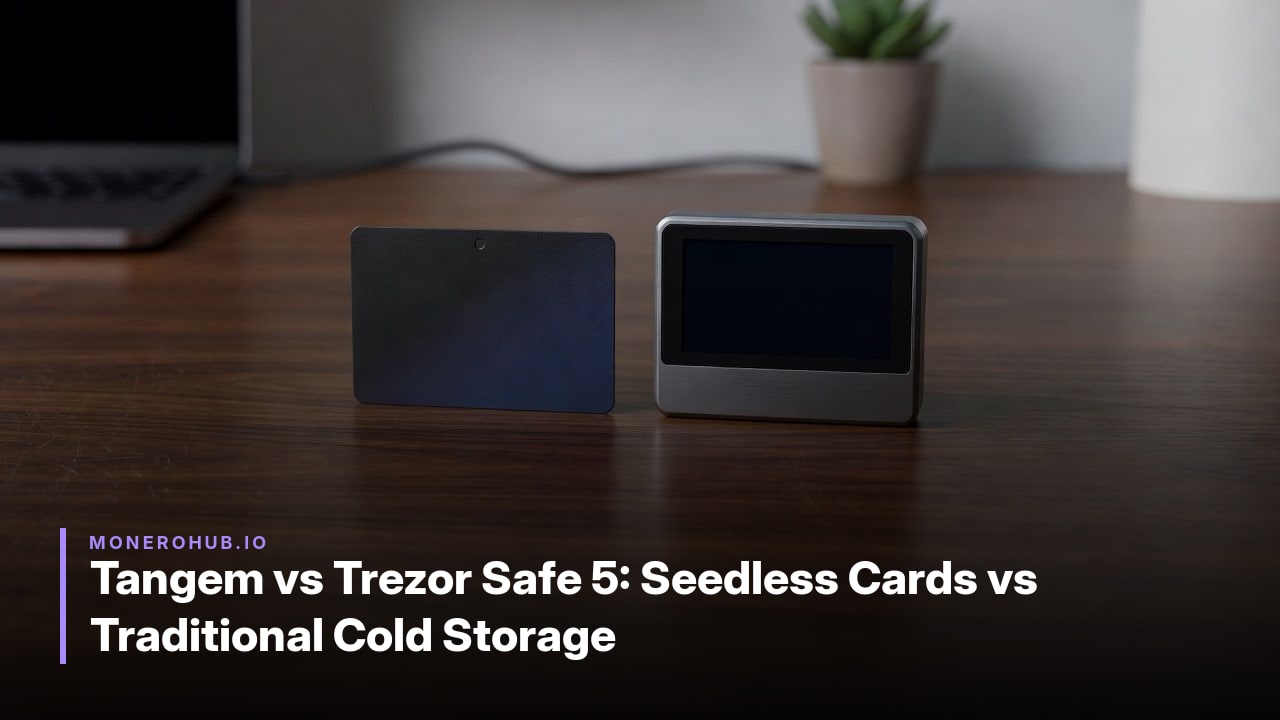
Tangem stores private keys on passive NFC cards built around an EAL6+ Samsung secure element. Because the cards draw power from the phone during each tap, they contain no battery or exposed ports, which shrinks the physical attack surface.
Signing occurs when a user taps the card to an NFC-enabled phone; the phone never sees the key material. Firmware on the card is immutable, so no updates can be pushed to alter its behavior after issuance.
By default the cards operate seedless. Backup is performed by cloning the key material from one card to one or two additional cards at setup time. An optional 24-word seed phrase can be generated if the user prefers conventional recovery, but the seed is never required for normal operation.
Each card carries a 25-year limited hardware warranty and an IP69K rating for dust and high-pressure water resistance. Tangem reports shipping more than 6,000,000 cards since 2017 with zero successful extractions of the secure element as of late 2026.
The Trezor Safe 5 is an aluminum USB-C device equipped with a 1.54-inch color touchscreen at 240x240 resolution, haptic feedback, and Gorilla Glass 3. It uses an NDA-free EAL6+ secure element to protect private keys.
Firmware is fully open-source, enabling public review and ongoing updates. The default backup employs the SLIP-39 standard with a 20-word multi-share scheme, allowing users to split recovery information across separate locations for added resilience.
A microSD slot supports firmware updates and data handling without requiring a constant host connection. Full integration with Trezor Suite delivers complete desktop and Android management, while iOS remains limited to view-only mode. The device covers thousands of assets across dozens of networks.
Released around 2024, the Safe 5 added the color display, haptics, and SLIP-39 enhancements. Warranty coverage is typically one to two years. Setup times reported in 2026 comparisons range from 5 to 20 minutes depending on the reviewer.
Tangem cards complete initial setup in under three minutes according to 2026 comparisons, while Trezor Safe 5 typically requires 15–20 minutes. The difference stems from Tangem’s NFC tap flow on a phone versus Trezor’s requirement to install Suite, verify the device, and generate or restore a backup.
Daily use follows the same split. Tangem signs transactions through a simple NFC tap in the mobile app, keeping the card passive and the phone as the interface. Trezor Safe 5 centers on desktop or Android Suite sessions, with the color screen providing on-device confirmation before any signature.
Both wallets support staking and DeFi while the private keys remain on the secure element. Tangem’s app offers in-app staking and swaps that route approvals through the card. Trezor Suite connects to compatible dApps via desktop or Android, again requiring physical device interaction for each signing step. Mobile-only users find Tangem’s workflow faster; those who prefer desktop verification and open firmware lean toward Trezor.
| Feature | Tangem | Trezor Safe 5 |
|---|---|---|
| Chip Certification | EAL6+ Samsung secure element | EAL6+ NDA-free secure element |
| Firmware Openness | Immutable firmware | Fully open-source firmware |
| Backup Method | Physical card cloning (seedless default) | SLIP-39 multi-share (default 20-word) |
| Coin/Token Support | 14,100+ tokens across 90+ blockchains | Thousands of assets across dozens of networks |
| Pricing Bundles (USD MSRP) | 2-card: $54.90–$55; 3-card: $69.90–$70 | $129–$169 |
| Warranty Length | 25 years | 1–2 years |
| Screen | None (NFC tap-to-sign) | 1.54-inch color touchscreen (240x240), Gorilla Glass 3, haptic feedback |
| Ports/Connectivity | None (passive NFC, IP69K rated) | USB-C, microSD slot |
| Attack Surface | Minimal; passive cards with zero successful extractions reported since 2017 (6,000,000+ cards shipped) | On-device verification with open firmware; no recorded successful chip extractions |
The table draws directly from manufacturer data and 2026 comparisons. Tangem’s seedless NFC model reduces physical ports and firmware attack vectors while Trezor’s open-source approach and screen enable explicit transaction checks. Both devices share EAL6+ certification yet diverge sharply in daily operation and long-term cost.
Tangem’s seedless NFC cards eliminate the single point of failure created by a written seed phrase, reducing the risk that a physical backup is photographed or coerced. Monero transaction privacy still depends on the wallet connecting to a node; both devices default to clearnet endpoints unless the user routes traffic through Tor or a trusted remote node. Trezor Safe 5’s open-source firmware and SLIP-39 shares allow verification of the code handling ring-signature construction, yet the mandatory seed introduces recovery vectors that Tangem avoids by design.
KYC on-ramps remain the clearest privacy leak for either device. Funds entering from an exchange tied to an identity can be clustered regardless of the cold-storage hardware that later signs the spend. Tangem’s mobile-first workflow increases the chance of IP exposure during NFC taps if the phone uses a mobile carrier without a VPN; Trezor’s desktop Suite can be run over Tor more easily but requires the user to manage that routing.
Concrete OPSEC steps for Tangem include cloning the backup card only on a clean device, never importing the optional seed phrase into software, and configuring the Tangem app to use a Monero node reached via Tor. For Trezor Safe 5, verify the firmware hash before every update, store SLIP-39 shares in separate locations, and enable passphrase protection on the device itself. Neither wallet makes Monero transactions impossible to analyze when the rest of the operational stack is left exposed.
Trezor Safe 5 lists at $129–$169. Tangem 2-card bundles run $54.90–$55 and 3-card bundles $69.90–$70, so the Trezor carries roughly double the entry price of a 3-card Tangem set.
Tangem lists 14,100+ tokens across 90+ blockchains. Trezor Safe 5 supports thousands of assets across dozens of networks. Tangem therefore covers a wider range of tokens by the published counts.
Tangem provides a 25-year limited hardware warranty and IP69K water/dust resistance. Trezor listings imply a standard 1–2 year warranty. The Tangem card also has no battery or ports, reducing points of physical failure.
Both devices list Monero among supported assets. Tangem’s NFC card approach keeps the private key on the EAL6+ element during mobile signing, while Trezor Safe 5 performs on-device verification through its touchscreen and open firmware.
Tangem cards are fully passive NFC devices with no USB or battery. Trezor Safe 5 uses a USB-C port and microSD slot, adding connectivity options but also additional attack surfaces that must be managed.
